Categories
Observation

Welling Court Mural Project – new murals 2012

In 2011 I interviewed Jon Ellis and Georgina Young Ellis about the Welling Court Mural project.  Last weekend artists painted new murals, coinciding with Welling Court’s annual block party.  Walk to the far Western end of 30th Ave to check them out.  And get a glimpse of some of them here:

Categories
Observation

Athens Square – hopefully not fenced off for long

Athens Square on 30th Ave is currently closed off to the sidewalk by a tall fence while some construction work is done.  It can still be accessed, via two gates round the side on 30th Street.  But it is amazing how the fence changes the whole feeling of the square.  One of its most effective features is the fact that it is so open to the sidewalk, so that the wide sidewalk and the square merge into one another.  Let’s hope that it is not closed off for long.

Athens Square epitomizes what I call an “open geography of the street”: an environment that facilitates interaction between people.  There are its benches and tables with chess boards marked on them where elderly people can while away hours right next to passers by.  There are two playgrounds for older and for younger kids, the open area where community events are held (and when free from events, kids kick footballs), and the basketball courts at the back.  Urban observers and writers like Jane Jacobs and William H Whyte (of the “Social Life of Small Urban Spaces”, the film of which is here) have emphasized how important this easy-mixing of people who use a space in different ways is to the smooth functioning of a neighborhood.

When kids skateboarding throughout the open area in Athens Square began to annoy other users, they weren’t just banned from the park with no place else to go.  The Community Board manager at the time George Delis asked them what they would think of having a big skatepark built in Astoria Park.  The park went ahead and now it is used by hundreds of skateboarders each day.  Boarders Philip Sparta and Wallace de Olivera who I interviewed for this blog said they use the new Skatepark all the time.  Yet significantly, they still come by Athens Square to see their friends on the basketball courts.

*******************************************

“Athena brushed with snow” – a previous post about Athens Square

Categories
Interview

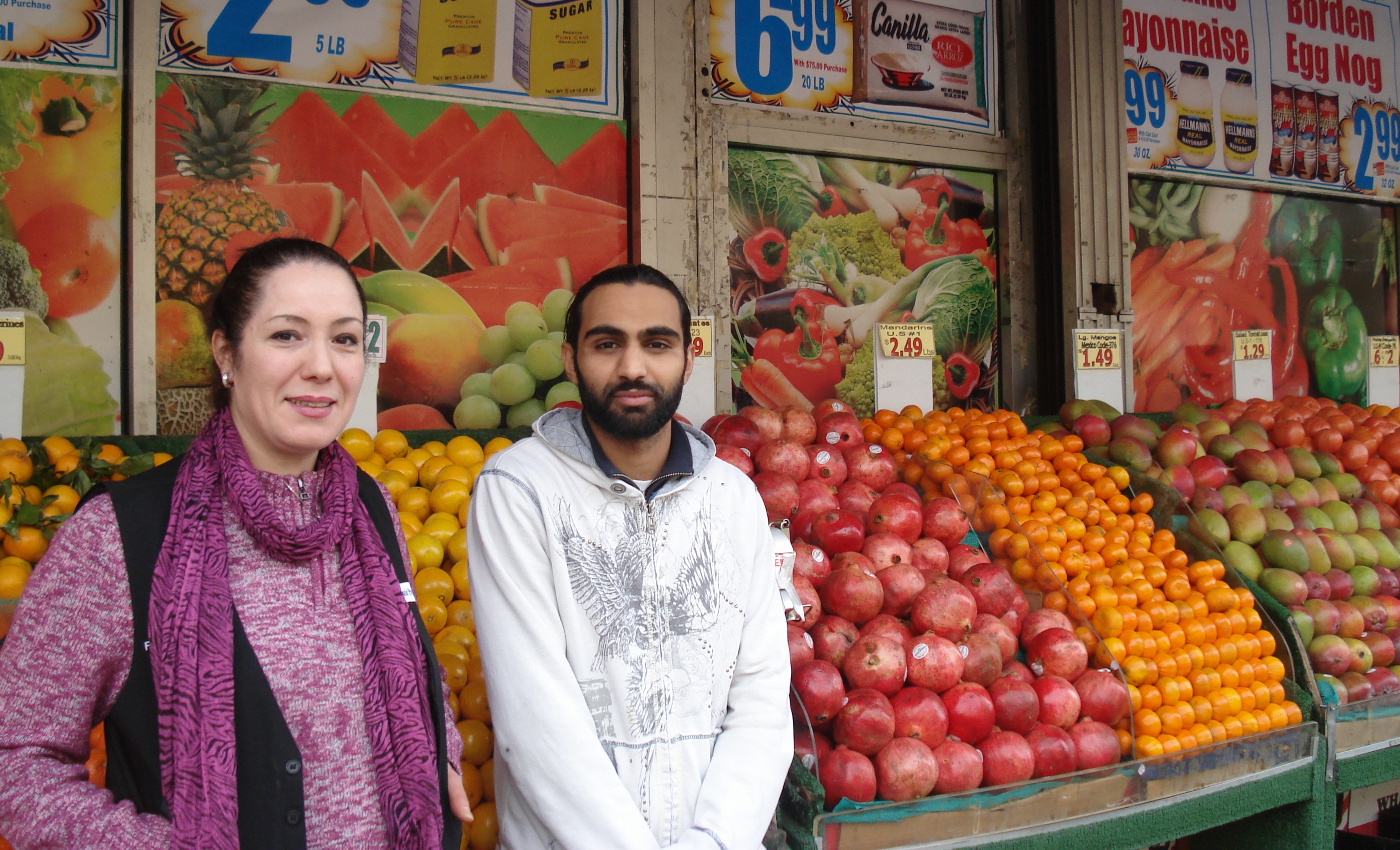
Mustafa Eid and Sabah Guessar – Trade Fair supermarket

This year I’m profiling interviews from the 2011 project in this spot at the top of the homepage.  At the moment, the interview with Mustafa Eid and Sabah Guessar of TradeFair Supermarket.  The original is here.  For an archive of  all 52 interviews click here.
Sabah Guessar and Mustafa Eid outside Trade Fair supermarket on 30th Ave

Trade Fair supermarket stretches along 30th Ave between 31st and 32ndStreets.  It’s a swath of color with its fruit and vegetables on display and bright announcements of special offers.  Among the bustle of customers and deliveries I spoke with its manager Mustafa Eid.  Sabah Guessar, also a manager there, joined in some of the conversation too, coming back and forth from her work.

“You can cross borders when you cross our aisles,” says Mustafa.  “No matter where you’re from you can always find what you want.  We probably have food from six or seven Middle Eastern countries.  From India, Pakistan, a good 12 countries from Latin America, from Europe, all around actually.  And I know where every single item is.”

Trade Fair began in 1974 when the owner walked into a small grocery store at the current 30th Ave location, as a customer.  He learned it was for sale and decided to buy it.  Now there are 11 locations throughout Queens.    Trade Fair’s website states, “Remember, we carry the foods of home. Wherever home may be.”

The most challenging part of Mustafa’s job is “making sure that every product that a customer asks for is on the shelf.  If someone requests something I look it up my book and try to find it and get it for them.”  The 110-120  staff at the store speak many languages between them.  Trade Fair advertises positions in the local Spanish, Arabic and other newspapers as well as online to make sure the team reflects the diversity of the customers.

Mustafa was born in Syracuse but moved at six months old with his family to the house in Upper Ditmars where he still lives now, at 25.  His father worked at Trade Fair from when it first opened.  “After I left school he talked to the boss and said, ‘listen, my son needs a job’.  I grew from the smallest position you can get, on the minimum wage.  Then I learned everything, and we’re doing a fine job here.  Oh I had to work hard for it…I built myself all the way up until I got this position.”

Prior to coming to the 30th Ave location he worked at the Trade Fair store in Ditmars.  “It’s very similar to 30th Avenue but not as exciting actually.  Over here is more diverse, much more diverse.”  He describes Ditmars as Astoria’s “quieter version”.

Mustafa’s hours are open.  “I don’t even have a schedule.  Whenever I get the chance to stay here I stay here, no matter how long it takes.  I can be here between nine to 16 hours.”  The store is open 24 hours and remains busy through to 2am.

Sabah adds.  “It’s busy at night, and safe.  Three o’clock in the morning I am here sometimes and it’s like I’m feeling home, I’m not feeling afraid.”

Mustafa says that he puts the safety of the area down to its diversity.  “Everybody knows the other person’s culture now.  You respect everybody.  Everybody respects you, you go on with your life and that’s it.”

Sabah: “The only one thing we all feel is that we’re all immigrants.  We try to be together.  Culture, religions, it doesn’t make no difference.  Colors, countries, languages…”

Sabah’s family is Moroccan and Mustafa’s is Palestinian, but as Mustafa says, “in this area, you don’t even ask where people are from any more.”

Sabah and Mustafa say that they get to know all their customers.  “If a customer disappears for 2-3 days it’s like ‘what happened, we didn’t see you for a while?” says Sabah.

Mustafa says he can only see himself staying Astoria.   As for his work: “hopefully I can get to be Vice-president of the company.  I can’t be the President [because the President’s the owner ].  But maybe I’d get Vice.  Hopefully!”

Categories
Interview

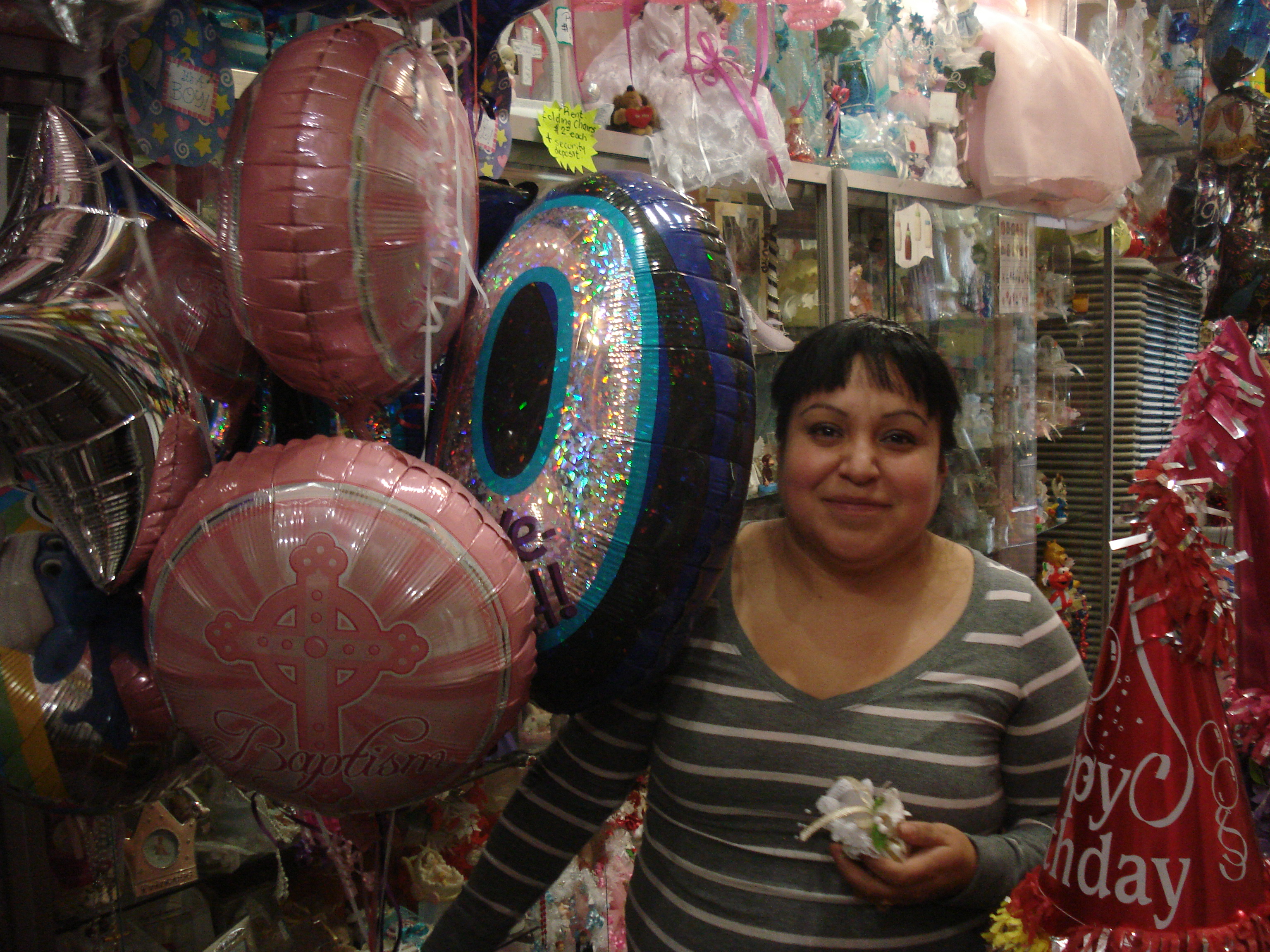
Elizabet Flores – La Bomboniera Marylu

Elizabet Flores in her store La Bomboniera Marylu at 35-17 30th Ave

Elizabet Flores owns La Bomboniera Marylu party store on 30th Ave.  What more festive way to end this year of interviews than a conversation with her.  “We are like a party planner,” Elizabet says.  “We can help you with first communions, christenings, birthdays, weddings.  We help you with the invitations, favors, decoration of the hall…anything that you need for the party.”

The store is brimful with party products.  Among them are its namesake and Elizabet’s own personal favorite item, the favors called bombonieras.  They are small packets of five sugared almonds wrapped in tulle or organza and tied with a ribbon.  On the ribbon are words appropriate for the party, like “happy birthday” or the names of the couple if they are for a wedding.

“It’s a French, Italian and Greek tradition, so I didn’t know about them before,” says Elizabet, who is from Mexico.  “When you tell the customers, they say, ‘you didn’t know what that means?!’”  The bombonieras are given for good luck.

Elizabet says that she is always learning from customers about their own party traditions.  “For the Greek orthodox people, we do things that they have for Easter, the candles and things like that.”  At Christmas time, local Ecuadorians hold month-long celebrations for the holy boy, divino niño Jesús.  “They do it like a party for the holy boy.  They make invitations, they have a mass, they have a reception and traditional dances.  So we help them with that.”

La Bomboniera also helps customers hold small parties in their homes.  “We can rent the chairs and the tables, and do a touch with a small cake.  We just work with the Dominican cakes.  We have a lady who makes them for us.  People like the Dominican cakes a lot.  Around the area on 30th Avenue they just sell like Italian cake, French.  The difference is the paste.  It should be like a pound cake, and the filling doesn’t have cream, it just has like a guava paste, or pineapple or strawberry or chocolate.”

The store has been on 30th Ave since 2004, and its previous owner ran it for some time before that on Roosevelt Avenue.  Elizabet says that how she became involved “is a funny story.  I was the cleaning lady of the previous owner.  She got married and one day said ‘I want to sell my business’.  I thought, ‘ok, I’ll have to look for another job’.  But I was talking with a couple of friends and my family, then I talked to her and said ‘why don’t you give me the opportunity to buy your business?’

“She helped me a lot.  Because I didn’t speak English at that time.  She was helping for four months, showing me.  I was trying to learn the most that I can.   Because her husband bought another business in Florida and she had to go.  I was like, ‘oh my God I have to learn!’”

“What I can tell you?  I can’t believe I was just the person who helped her at her house and now I own her business.  Once a year she still calls me.  ‘Elizabet, how’s everything, you doing good?’”

Elizabet says that she tries to be involved with each customer as if she is planning her own party.  “In that way I think they are going to be happy and they are going to come back.  I try to keep all of my customers.  It was a very hard time when I started, but now I can tell you thank God, everything is ok.”  Her mother and her sister help her in the store.  She says that being able to work with them and the face-to-face interaction with her customers are what she enjoys most about running the store.  When her own two children have parties, she even invites a few of her customers along to join in.

If she doesn’t have an item a customer needs she does her best to find it.  “If I don’t understand exactly what they want, I just say ‘can you explain again?’  And I’ll do it.  Of course!”

La Bomboniera Marylu

Next door to La Bomboniera is Astoria Music (interview with George Phillips here), and two doors up is Astoria Billiards (interview with Carlos Sanclementi here).


Categories
Interview

Sid – Emergency Medical Technician with NYC Fire Department

An NYC Fire Department van parked outside Mount Sinai on 30th Ave

Sid is an Emergency Medical Technician (EMT) with the New York City Fire Department.   He covers “pretty much anywhere on the West end of Queens.”  I spoke with him on a bitterly cold Sunday morning while his ambulance was parked outside Mount Sinai Hospital on 30th Ave.

Sid says that the work involves “anything from picking up drunks on the street, to cardiac arrests and severe trauma jobs.”  He enjoys helping people through his work – to the extent that as well as working the shifts of his job (each eight or sixteen hours), he also volunteers as an EMT around Suffolk County in Long Island, where he lives. 

But EMTs often don’t get the credit for their work, he says.  “With most of the stuff that we do here in NYC, we pretty much have the Fire Department in front of us.  The Fire Department get the credit and we don’t.  Pretty much we take care of the patients, they take care of the fire.  So whoever they bring to us, we take care of them.  Half-dead, we bring them back alive.  We bring them back here [to the hospital], and that’s the end of it.

“Sometimes, especially when there are family members around, about half of them they come to you and do say thank you, others they just don’t really care.”

Sid says that the sytems are different in Long Island and New York City.  “In Long Island we do everything at once.  We do fire, rescue, and ambulance first aid at the same time.  Here it’s separate.  Fire is fire, EMS [Emergency Medical Services] is EMS.   I think it works a lot better when everything is together.”  One reason he has continued volunteering in Long Island, which he has done for a long time, is because of the excitement of doing a bit of everything.

Training for being an EMT includes first aid, basic life support, and CPR.  Sid says that in New York the training is about three months and in Long Island it is six.  In the future, he hopes to go on to be a paramedic, and beyond that, a physician’s assistant or a nurse.

Of Astoria, Sid says, “the neighborhood around here is pretty good, depending on which way you look at it.  There’s a lot of diversity around here.  On one side you have Brazilians, on this side Italians, again on the other side you have Middle Easterners, and then back here there are people from Greece.”

Sid was born in Colombia and came to the US when he was young – he has been here for 27 years now.  “I’ve been back to Colombia seven or eight times,” he says.  “It’s a little expensive to go down there!   And other than some family and some of my elementary school friends I don’t know anybody there now, so it’s a little different.”

Sid says the Colombian community in Astoria is much smaller than in Jackson Heights, where many of the Colombians in NYC live.  Now, he says, many are moving out to Long Island.

Categories
Interview

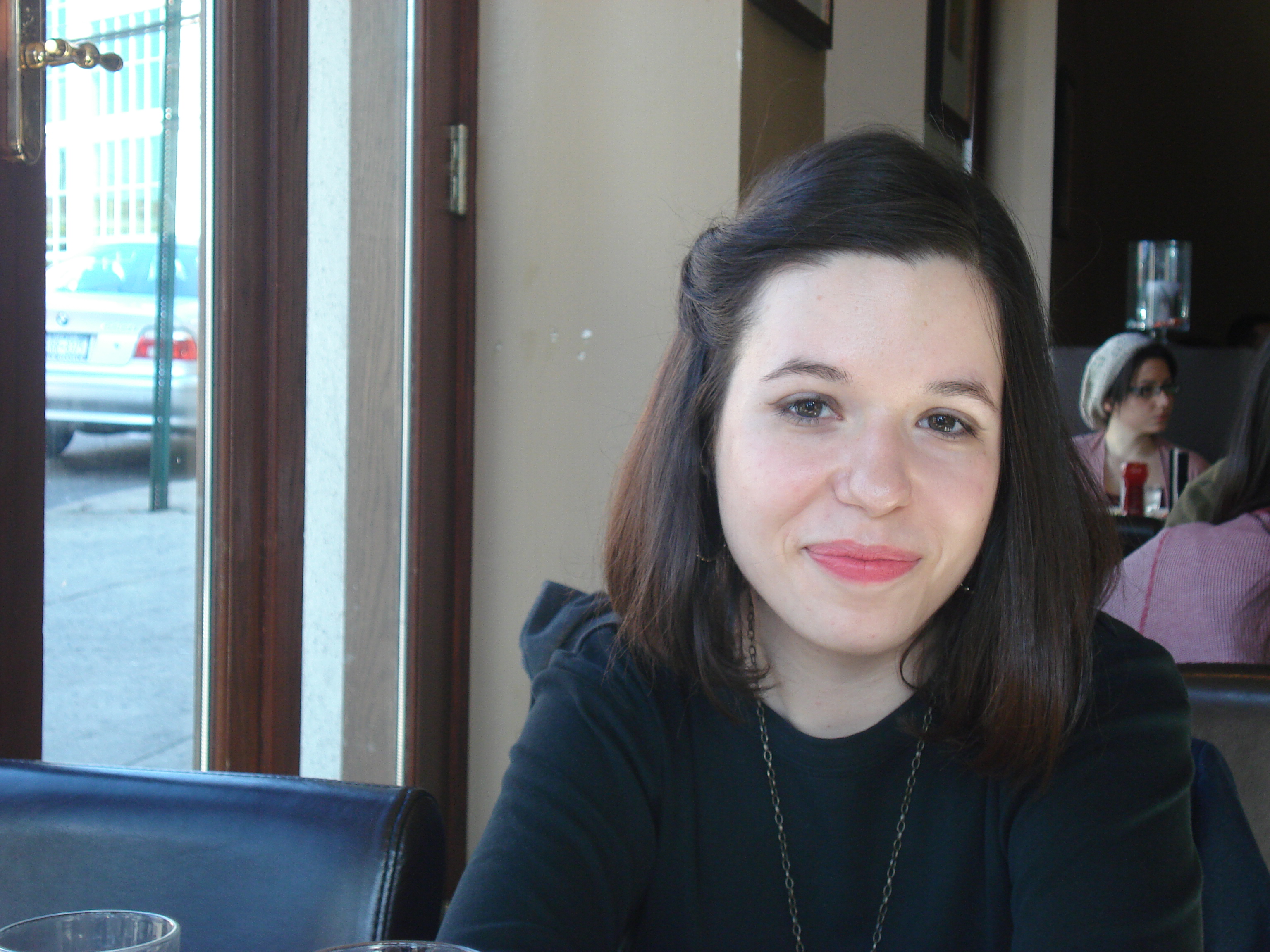
Jeanne Marie Boes – Singer and songwriter

Jeanne Marie Boes

Jeanne Marie Boes, now 23, was born and brought up in Astoria.  She used to live on Newton Avenue and for the past 11 or 12 years has lived on 30th Avenue.  There was a Casio keyboard lying around at home when she was a child.  She liked playing about on it, and hasn’t looked back since then.

“I’ve always leaned towards music, she says.   She went to Astoria’s Frank Sinatra School of the Arts. “It was a wonderful atmosphere there.  Lots of music, drama and art.  I would go back if I could.  Just to make it easy again.  Getting out of the real life, you know!  If I could do it over I would,” she says.

Real life for her now is working as hard as she can on her music.  She’s a singer, songwriter and musician.   “Really what I’m aiming for is making people smile.  For them to walk away happy with what they heard.  Which is ironic perhaps – a lot of my music is blues.”

Blues and jazz are her main genres but in some recent songs like “If It’s Goodbye” she has moved more into pop.  Her inspiration is other musicians, especially those she heard while she was growing up, like Frank Sinatra, Judy Garland and Ella FitzGerald – also the Beatles and Billy Joel.

Two words she would use to describe Astoria are “emerging” and “inspiring”.  “There are all these new businesses and restaurants.  30th Ave, Broadway, and Steinway, it seems like they are really booming.  Astoria is just gorgeous.”  She plans on staying.  Until, that is, “I move to my dream loft in the village.”

Along 30th Ave, Jeanne has played in The Quays and Shillelagh Tavern.  And she plays throughout the city.  While Queens music venues are on the increase, she says that Manhattan is still where most of the opportunities are.  “It’s more competitive.  But also there is a lot going for you and you have a lot of chances.”

Last year Jeanne was a finalist for Queens in the “Battle of the Boroughs” music contest.  She performed  “A Seasoned Heart” in WNYC’s Jerome L. Greene Space (known as the Greene Space).  She was excited to be playing right next to WNYC radio, home to one of her favorite stations WQXR.

Earlier this year she brought out her latest album, an EP called “Promising Girl.”  Now, she’s performing her songs wherever she can.  And she is carrying on with what she enjoys most about being a musician: “Coming up with a good tune.  Creating the music.”

– Jeanne Marie Boes’ website

Categories
Interview

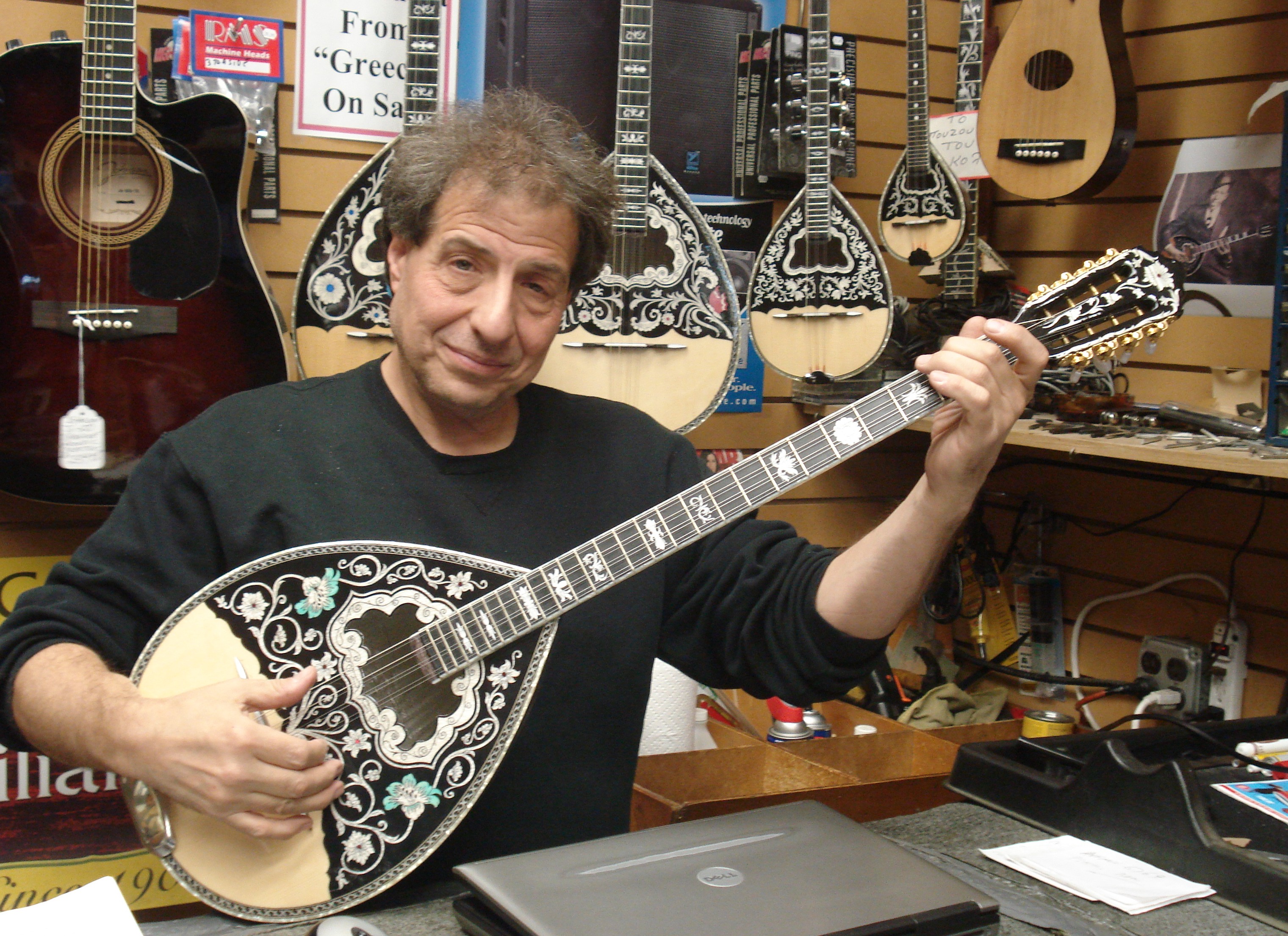
George Phillips – Astoria Music

George Phillips of Astoria Music, with a bouzouki

George Phillips worked as a NASA engineer for eight years, before a change of direction in 1982 when he took over Astoria Music at 35-19 30th Avenue.  The music store has been there since 1922.  George says that it is Astoria’s third oldest business, after Ronzoni  pasta company on Northern Boulevard (though that is no longer there) and the Steinway Piano factory (which is).

Astoria Music sells the whole range of instruments, does repairs, and also runs a music school.  In its early days, it was also a “straight to vinyl” recording studio.  Its website lists well-known musicians who have either recorded or bought merchandise there.

One of Astoria Music’s specialties is hand-made bouzoukis from Greece.  “I average anywhere between six to seven bouzoukis a month,” George says.   “This is the only music store in America that sells bouzoukis like this – well, the real thing.  There are lots of imitations.  This is the real thing.”

Bouzoukis are in the same family as the guitar, but tuned one step lower than a guitar so that their open strings are D-A-F-C.  As well as running the store, George, who is Greek American, plays the bouzouki professionally – he has done so for around 45 years.   “We do corporate events, shows, festivals, weddings…traditional Greek music and also top 40 American oldies, stuff like that.”

George says that the neighborhood has changed little over the years, other than the arrival of more restaurants and some changes in the stores.  “The houses are the same.  The character is the same because of the European influence around here.    There are still a lot of Greeks.  Italians, Yugoslavians, people like that, they have kept their homes here.  That’s what keeps the neighborhood halfway decent.  People clean their front yards, they care about their homes.  They’re homeowners.”

George laments the fact that the number of live music venues is on the decline.  He says it may be less pronounced in Astoria and other parts of New York than elsewhere in the US, but all the same they are “slowly, slowly fading out.”  In his view, it is because “a lot of the music written today is un-reproducible.  There’s just a lot of junk out there.  Bands don’t play that kind of music…it’s the DJ playing it.

“Even as recently as 20 or 30 years ago, in one year you would have 200 songs, brand new songs that were written by different artists.  Out of those 200 songs, about 180 of them are still being played today as standard.   Beautiful songs.  Some Sinatra songs, Billy Joel songs, or Beatles tunes from back in the ‘60s.  Still being played.  Today, you would also have 200 new songs that are out right now.   They’re considered a big hit.  But you will never hear that song again in six months.  They are dead.”

Despite changes to the music scene, Astoria Music will likely be a feature of 30th Ave many years from now.  A wide range of musicians in the neighborhood frequent it.  And George Phillips is committed.  “I love what I do.  Music in any form, music only makes life better.”

Categories
Interview

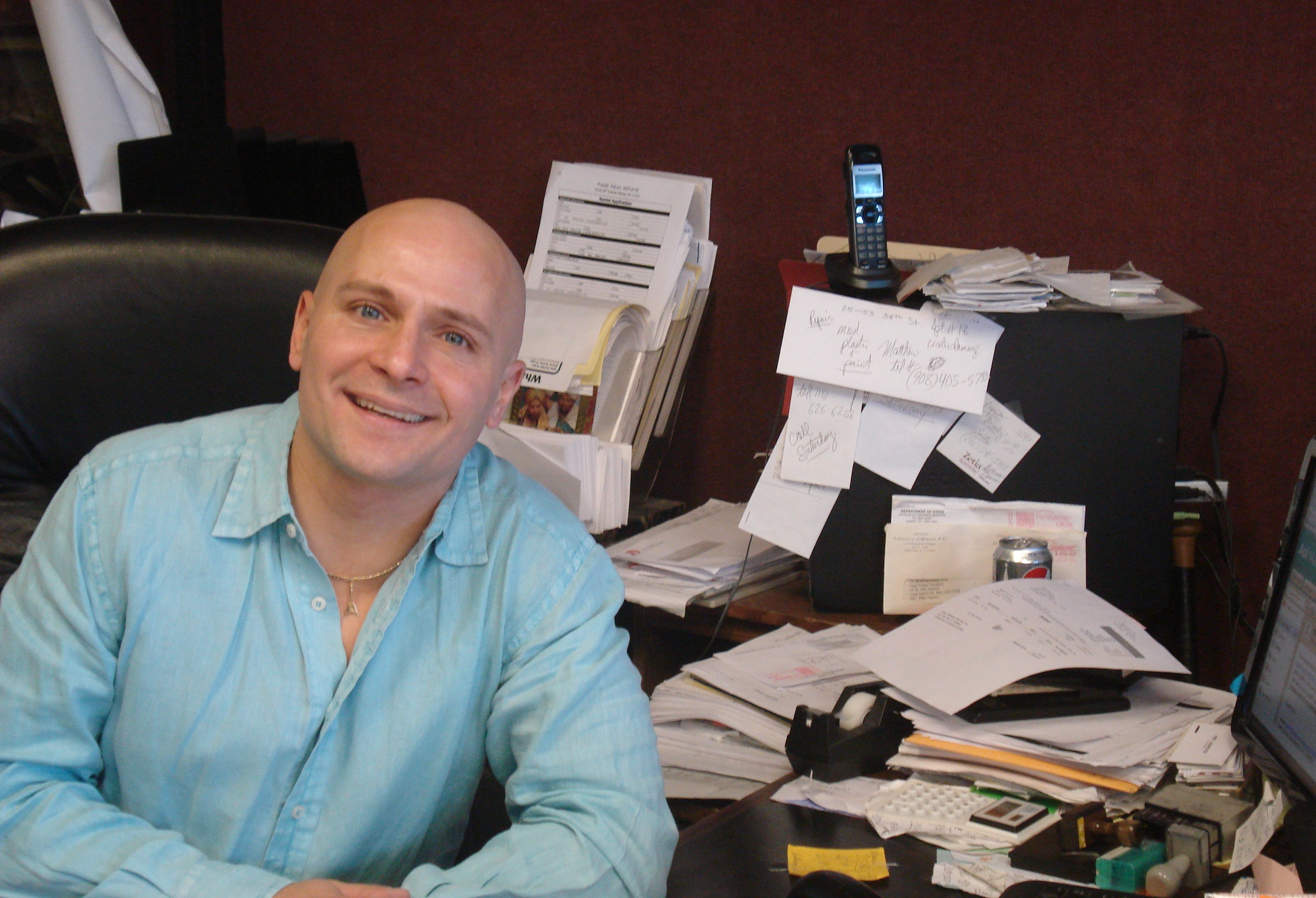
Michael Pagano – Page Real Estate

Michael Pagano of 30th Ave's Page Real Estate

Page Real Estate has been on 30th Avenue since 1961.  It’s now at 35-20 and used to be just a couple of blocks down the road.

Anthony Louis Pagano founded the business, then handed it to his son, Anthony J Pagano, who sadly passed away last month.  I spoke with Anthony J’s son, Michael, who has been working in the business for 25 years.  His brother and sister also work there; as the company’s website says, it’s the longest-running family operated real estate business in Astoria.  Michael says that both his grandfather and father instilled in him “a solid work ethic, strong family values, and honesty in dealing with the public.”

“You meet cross sections of all humanity,” says Michael, on what he enjoys about his work.  “And you help people find new homes, make new beginnings.”  As for the challenges, Michael says there are plenty.  One in Astoria is finding enough pet-friendly homes for dog owners.

Page Real Estate mainly deals with pre-war rent-stabilized apartment buildings.  On house prices generally in Astoria, Michael says that despite the economic downtown they have remained steady.  “That’s due to a steady demand, nearby jobs, the locality, and also now the nightlife.”

The nightlife wasn’t always a feature.  Michael says that 25 years ago “everything closed at six or seven at night.  There would be just a few places open between the subway station to Steinway – like a fruit store, and one or two coffee places.”  Of course that’s no longer the case, with restaurants and cafes on every block.  “It’s brought a nice group of young professionals.”

He adds that the neighborhood is relatively inexpensive, safe, and close to everything.  “It’s the greatest secret in New York City.”

Categories
Interview

Mustafa Eid and Sabah Guessar – Trade Fair supermarket

Sabah Guessar and Mustafa Eid outside Trade Fair supermarket on 30th Ave

Trade Fair supermarket stretches along 30th Ave between 31st and 29th Streets.  It’s a swath of color with its fruit and vegetables on display and bright announcements of special offers.  Among the bustle of customers and deliveries I spoke with its manager Mustafa Eid.  Sabah Guessar, also a manager there, joined in some of the conversation too, coming back and forth from her work.

“You can cross borders when you cross our aisles,” says Mustafa.  “No matter where you’re from you can always find what you want.  We probably have food from six or seven Middle Eastern countries.  From India, Pakistan, a good 12 countries from Latin America, from Europe, all around actually.  And I know where every single item is.”

Trade Fair began in 1974 when the owner walked into a small grocery store at the current 30th Ave location, as a customer.  He learned it was for sale and decided to buy it.  Now there are 11 locations throughout Queens.    Trade Fair’s website states, “Remember, we carry the foods of home. Wherever home may be.”

The most challenging part of Mustafa’s job is “making sure that every product that a customer asks for is on the shelf.  If someone requests something I look it up my book and try to find it and get it for them.”  The 110-120  staff at the store speak many languages between them.  Trade Fair advertises positions in the local Spanish, Arabic and other newspapers as well as online to make sure the team reflects the diversity of the customers.

Mustafa was born in Syracuse but moved at six months old with his family to the house in Upper Ditmars where he still lives now, at 25.  His father worked at Trade Fair from when it first opened.  “After I left school he talked to the boss and said, ‘listen, my son needs a job’.  I grew from the smallest position you can get, on the minimum wage.  Then I learned everything, and we’re doing a fine job here.  Oh I had to work hard for it…I built myself all the way up until I got this position.”

Prior to coming to the 30th Ave location he worked at the Trade Fair store in Ditmars.  “It’s very similar to 30th Avenue but not as exciting actually.  Over here is more diverse, much more diverse.”  He describes Ditmars as Astoria’s “quieter version”.

Mustafa’s hours are open.  “I don’t even have a schedule.  Whenever I get the chance to stay here I stay here, no matter how long it takes.  I can be here between nine to 16 hours.”  The store is open 24 hours and remains busy through to 2am.

Sabah adds.  “It’s busy at night, and safe.  Three o’clock in the morning I am here sometimes and it’s like I’m feeling home, I’m not feeling afraid.”

Mustafa says that he puts the safety of the area down to its diversity.  “Everybody knows the other person’s culture now.  You respect everybody.  Everybody respects you, you go on with your life and that’s it.”

Sabah: “The only one thing we all feel is that we’re all immigrants.  We try to be together.  Culture, religions, it doesn’t make no difference.  Colors, countries, languages…”

Sabah’s family is Moroccan and Mustafa’s is Palestinian, but as Mustafa says, “in this area, you don’t even ask where people are from any more.”

Sabah and Mustafa say that they get to know all their customers.  “If a customer disappears for 2-3 days it’s like ‘what happened, we didn’t see you for a while?” says Sabah.

Mustafa says he can only see himself staying Astoria.   As for his work: “hopefully I can get to be Vice-president of the company.  I can’t be the President [because the President’s the owner ].  But maybe I’d get Vice.  Hopefully!”

Categories
Interview

Frank DePaola – Sorriso Italian Salumeria

Frank DePaola of Sorriso Salumeria on 30th Ave

Frank DePaola was born in Calabria, Italy and moved to the US when he was eight years old.  His family first lived in Long Island before coming to Astoria.  Thirty three years ago he opened Sorriso Salumeria, an Italian delicatessen at 44-16 30th Ave.  “Sorriso” means smile in Italian.

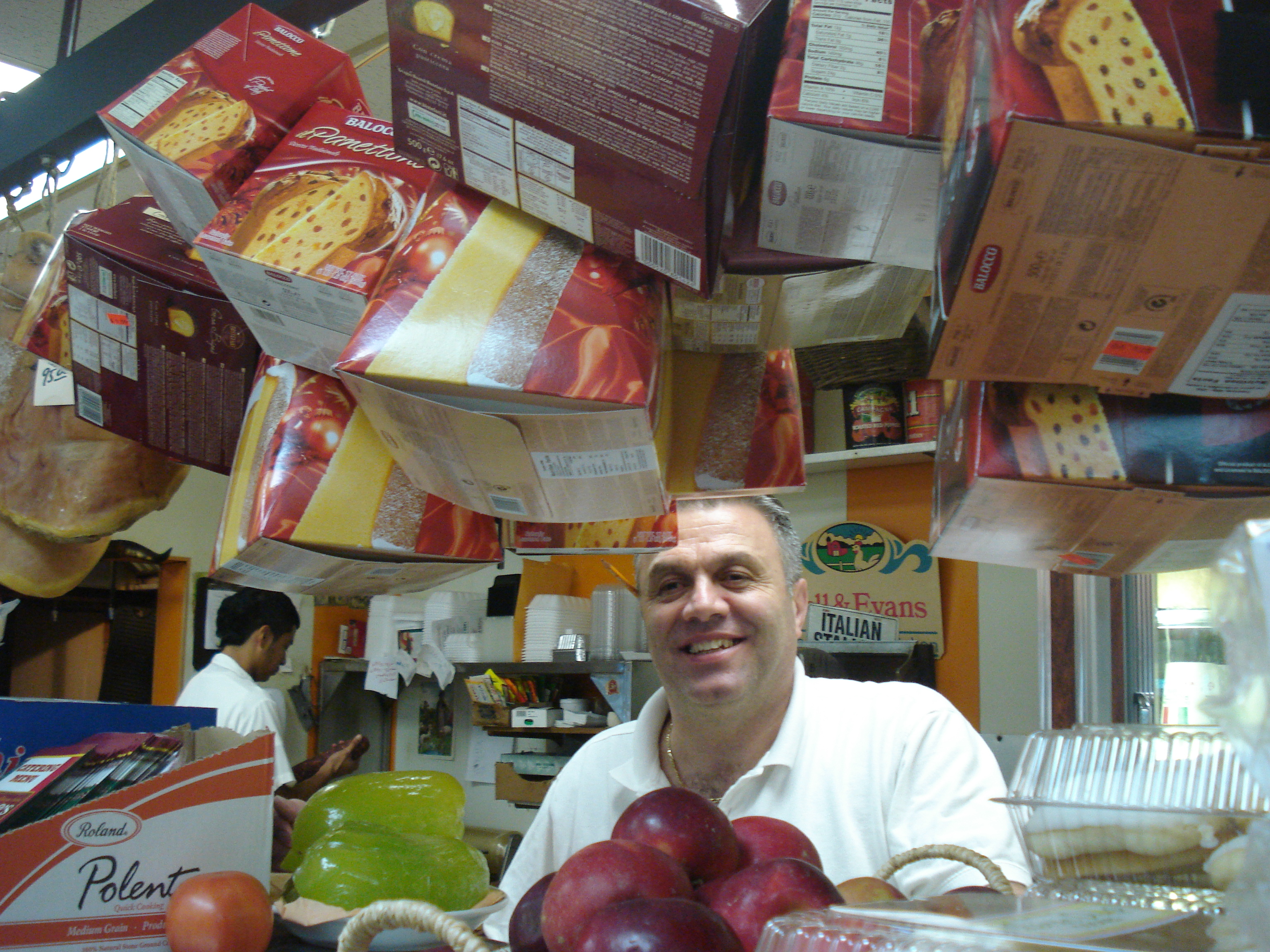
“We specialize in hard-to-get items,” Frank says.  “Cheese, fresh-baked breads, sausages, meats, whatever you need.”  His favorite product from the store is their mozzarella, which they make fresh every hour.  The store also sells pasta and pasta sauces, prepared foods like lasagna and meatballs, and it does catering for parties.  At the moment with Christmas approaching the ceiling is laden with hanging Panettone cakes.

“I give a lot to the store,” says Frank.  “One hundred and ninety percent.”  Sorriso’s is open seven days a week.  Frank takes Wednesdays off and the fact that his son, who recently finished college, now works with him means he can “relax a bit.”  But he adds: “When I’m off, I’m out getting stuff, or I’m going to the bank.  You know, it’s always something.”

Frank has not returned to Italy since moving to the US in 1966.  “I could leave for seven to ten days but I’m so attached I can’t!  My wife says I’m crazy, but it’s my passion, I love it.  This has been my dream.  I love this business so I don’t consider it coming to work every day.”

Frank jokes that the stretch of 30th Ave from Steinway to 57th Street “used to be quiet until I got here!  We support each other.  There’s the bakery (Gianpiero), the liquor store.  We all support each other.”

Frank says Astoria’s Italian community is smaller than it used to be.  Some have “gotten older, they’ve moved away, some went back to Italy, they left us…”  But at the same time, some of the original generation’s children and even grandchildren are still in the neighborhood, and still frequent Sorriso’s.

“We also have an influx of younger people moving into the neighborhood – 25-35 years old, young professionals.  They know good food, they love good food, and they know what to expect when they come in to buy something.”  They also use the internet to track down what they want, Frank adds.

Technology also means that the hard-to-get products that Sorriso’s specializes in are now less hard-to-get.  “It’s easier to get stuff from Europe than it was 10 years ago.  Everything is computerized…it doesn’t take as long to approve labels and everything.

“Sometimes people want a special item.  I ask the importers to bring it in for me and they do.  As my son says, ‘Dad, it’s the computer age’.  I mean I’m not a computer guy.  But absolutely it helps the business.  Everything’s twice as fast.”